
Location
Littleworth Nature Reserve extends along the old railway land from the west end of Littleworth to Sandy Lane in Horspath.
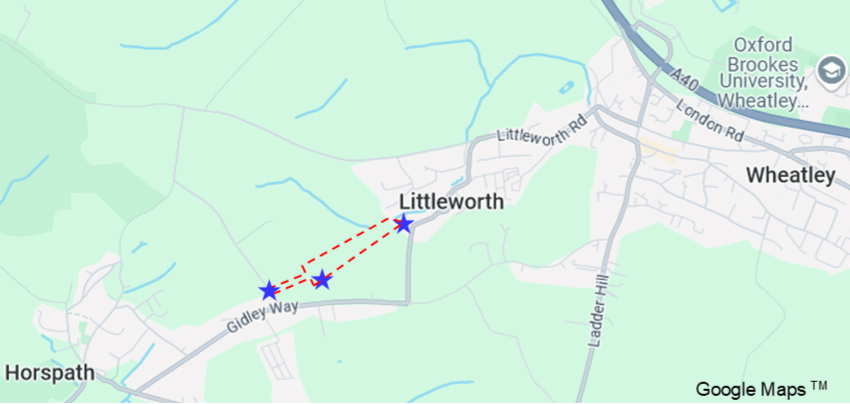
It can be accessed from the footpath between Littleworth and Old Road, Wheatley, from a kissing gate on the footpath from Littleworth to Gidley Way, Horspath and from Sandy Lane, Horspath. The accesss points are shown by the blue stars on the map above. The nature reserve is open all of the time.
History
The railway between Princes Risborough and Oxford was completed in 1864, and was built as a single track line using Brunel’s broad gauge of 7 ft and 1/4 inch, but was converted to standard gauge (4ft 8 1/2 inch) in 1870. The railway closed to passengers in 1963, and to all traffic in 1968. The track was lifted in 1969.
The cutting was used as a tip for domestic waste between 1972 and 1974. After tipping had finished, the waste was covered with 1.5 metres of clay and 0.5 metres of subsoil, and in 1978 trees were planted and areas grassed. The land is owned by Oxfordshire County Council.
More information about the history of the site can be found in the Wheatley Village Archive.
A Brief Tour
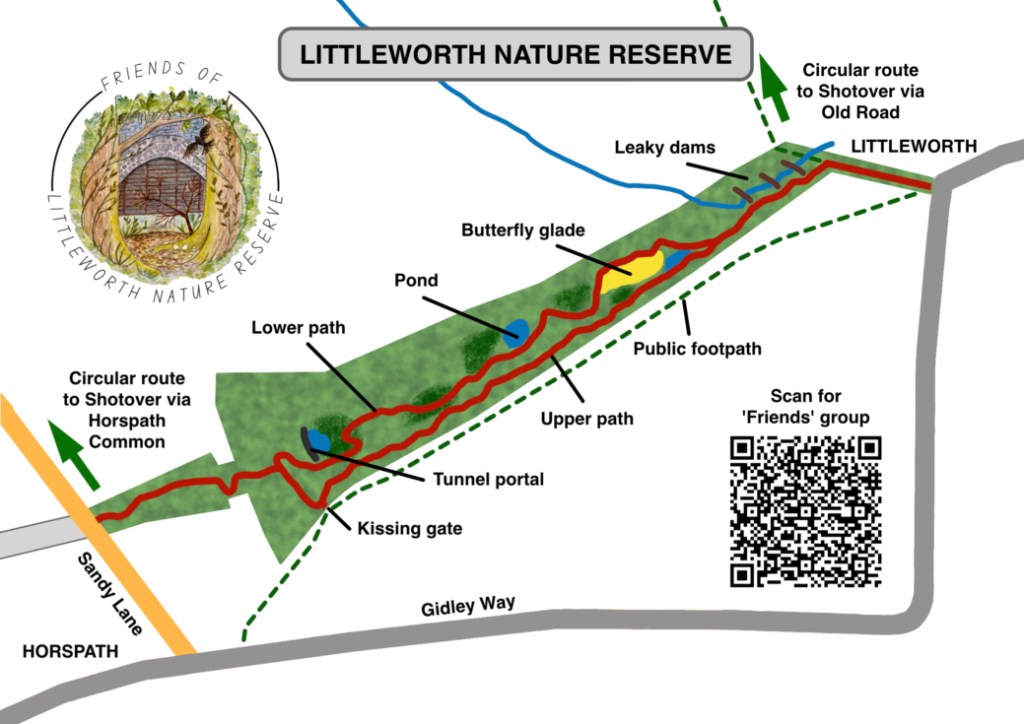
Starting from Littleworth, the entrance to the Nature Reserve is from the footpath that goes from the western end of Littleworth village to Old Road in Wheatley. Where this footpath goes down the steps to the bottom of the railway cutting you can see the ‘leaky dams’ installed in spring 2024 as flood mitigation measures.
Access to the Nature Reserve is from this footpath at the top of the steps on the south side of the railway cutting. Shortly after passing the board with the map you will hear water running. This is a stream that flows down from the north side of the cutting and then enters a culvert. This stream emerges at the Old Road/Keydale Road junction in Wheatley.
Shortly after the map board, there is a fork in the path; the right fork (the Lower Path) goes along the bottom of the railway cutting, and shortly enters a cleared area known as the butterfly glade. The path goes on, passes a small pond and the railway cutting gets deeper.
We have recently cleared some branches above the pond and raked the dead wood and leaves from the pond. We hope that this will encourage amphibians and other pond life.
Eventually you reach the tunnel mouth, which is bricked up, with a high level grating to allow access for bats, which roost in the tunnel. The bottom of the tunnel mouth is some way down from the path, and this gives an idea of the depth of infill in the cutting, when the land was used as a rubbish dump.
A short way back from the tunnel mouth there is a path, with some steps, that climbs up the south side of the cutting, and goes above and behind the parapet of the tunnel mouth. This path then loops round, and there are two branch paths that go off to the right. The first enters private property, and shortly after this a second path gives access to Sandy Lane, Horspath.
The Sandy Lane path was created in autumn 2024, and there is a short section at the top of an embankment where you get views across the fields. This embankment is actually a spoil tip from when the tunnel was dug – two temporary shafts were dug down, and this tip is where spoil from one of the shafts was dumped.
Coming back to the main path, this leads on to where there is a kissing gate that opens on to a field, and from here you can join the footpath that goes from Littleworth to Gidley Way in Horspath.
From the kissing gate there is another path (the Upper Path) within the the nature reserve that follows the boundary fence, eventually joining back on to the Lower Path.
Details of the Habitats
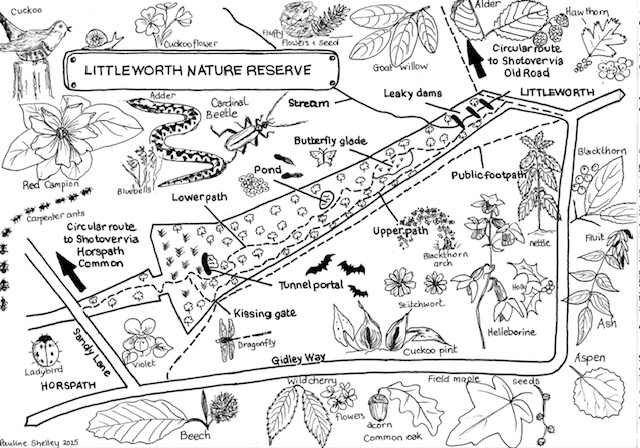
The Boardwalk and Lower Path – Littleworth entrance
There is thick vegetation around the Boardwalk, which consists of the water loving plants. In wet spells, water streams through here along the old railway bed. You will see the Leaky Dams, built from willow, to stem the flow of water and prevent flooding further down, in extreme weather conditions. This will take a few years to establish. This is a good place to hear birdsong. Look out for dragonflies and damselflies.
The lower path is lined by nettles which are host to many different species of butterflies and insects.
The Pond area is fed by underground springs and in dry weather becomes a bog. Sometimes in the Spring, there are tadpoles, but they haven’t been seen in recent years. The Horsetail is a striking plant which dates back 350 million years. It loves the damp marshy ground and reproduces via rhizomes and doesn’t produce any flowers. Look out for dragonflies and damselflies which like to hover above the water in Spring/Summer. The wet areas are essential for the bats and birds which hunt for insects. Further on along the path you will see many fallen trees. It is dark, cool and damp here therefore there are many fungi, mosses, lichens and liverworts to be found on rotting wood, during wet spells and winter months.
Butterfly Glade
This area is more open and allows the sunlight in to encourage meadow plants to grow. Here you will find grasses, umbellifers, wild flowers and subsequently insects and butterflies which thrive in this type of habitat. Bug hotels have been created with decaying wood from fallen trees. The Friends Group of Volunteers help to maintain the meadow by cutting and clearing during the Summer.
Some areas in the glade are boggy, attracting the soft rushes and marshy plants. There are blackberry bushes along one side which attract the butterflies and bees when in flower, and birds like to feed off the blackberries in late Summer.
One of the main features in the glade is the leaning Aspen tree. Look out for its diamond shaped, black markings on its silvery trunk, (lenticles). The silvery rounded leaves flutter and quake in the breeze, giving it the name, Quaking Aspen. The tree was probably planted in the 1970’s in their attempt to cover and landscape the cutting.
There is a Slow worm hotel hidden behind the Blackberry bushes.
The Tunnel
The tunnel was sealed up both ends from public access in the early 90’s. It is just over a quarter of a mile long, with a slight bend in the middle. Now, it is home to several species of bats. Bat boxes have been placed in the tunnel and it is thought that there are four main species present; Natterer’s, Daubenton’s, Brown Long-eared and Barbastelle. Tell our volunteers if you would like to join our bat enthusiasts, to listen to their echolocation calls on our bat detectors. We meet some evenings, just before sundown when the weather conditions are favourable.
The area around the tunnel entrance is permanently damp, fed by streams running off the hill. The light level is low during the summer months when the leaves are on the trees. In the winter, look out for fungi – Scarlet Elf Cups which grow on the rotting wood pile. In the Spring, bird song is amplified by the steep sides of the cutting and there is sometimes an eerie silence when the birds have ceased their springtime activities. A steep, partly stepped climb to the left of the tunnel leads to the upper path and links to a new path to Sandy Lane.
Above the Tunnel
The area above the tunnel is covered with bracken during the late Spring and Summer. Hidden amongst the bracken is a reptile refuge; a metal covering which provides a warm habitat for Adders and Grass snakes. During late April, early May, Bluebells emerge across this area.
Butterflies often are seen dancing their mating rituals in the sunlight. In the evenings at dusk, the bats can be spotted darting from tree to tree in their hunt for for insects.
For a longer walk, take the new path up towards Sandy Lane and join up with Shotover fields.
As you turn to walk back around the loop to the upper path, look out for dragonflies and damselflies by the kissing gate. They hover above the nettles on sunny days in the late Spring-Summer.
The Upper Path
The upper path loops round and runs parallel to the lower path but on a higher level. Here, you are afforded wonderful views down to the tunnel and Butterfly Glade.
This path leads you downhill and under the Blackthorn arches which are covered in white blossom in early Spring. Look out for the Ash tree with a vertical split in one of its trunks. It was thought to heal sick children if you passed them through the hole! There are several Oak trees along the embankment. Their vast branches spread wide and provide a rich habitat for the birds and insects.
Stitchwort, Figwort, Violets, Foxgloves, and Bluebells are among some of the wildflowers which grow along the edges of the path, but in July 2024 we made an exciting discovery! Helleborines were discovered, just before it joins with the lower path. These plants are quite a rare sight. They belong to the orchid family and flower from July to September. Helleborines have a complex system of reproduction which involves the mycorrhizal fungi in the ground. It is now important that we monitor and protect these plants for the future.
Wildlife Reference
An excellent guide to the local wildlife is the book “Shotover. The Life of an Oxfordshire Hill”, ed. Ivan Wright and Jacqueline Wright, Pisces Publications, 2018. ISBN 978-1-874357-87-2
Wildlife Survey: Introduction
We are trying to compile a list of the wildlife in the Nature Reserve – see below. This is very much “work in progress”, and we would like to improve and update it. If you want to add to it (or correct it!), please contact us by:
- Post on the Faceb0ok page of Friends of Littleworth Nature Reserve
- Send an email to [email protected]
Wildlife Survey: Data
Click on the arrow to see the tables of data. Note that this is work in progress.
In 2013 Jacqueline Wright, of Shotover Wildfile, carried out a survey of bryophytes (mosses and liverworts) in the Nature Reserve. This data is indicated by 2013, JAW in the notes column; more recent observations are dated. Our thanks to Jacqueline for this data.
Last updated 11th April 2026
Birds
| Bird | Notes |
|---|---|
| Blackbird | |
| Blackcap | |
| Blue Tit | |
| Bullfinch | (Merlin app) |
| Carrion Crow | |
| Chaffinch | |
| Chiffchaff | |
| Coal Tit | |
| Collared Dove | |
| Common Redstart | (Merlin app) |
| Cuckoo | Heard 30 April 2025 |
| Dunnock | |
| Fieldfare | |
| Firecrest | (Merlin app) |
| Goldcrest | |
| Goldfinch | |
| Great Spotted Woodpecker | |
| Great Tit | |
| Greenfinch | |
| Green Woodpecker | |
| Grey Wagtail | |
| Jackdaw | |
| Jay | |
| Long-tailed Tit | |
| Magpie | |
| Mistle Thrush | (Merlin app) |
| Nuthatch | (Merlin app) |
| Red Kite | |
| Redstart | (Merlin app) |
| Redwing | |
| Robin | |
| Siskin | |
| Song Thrush | |
| Spotted Flycatcher | (Merlin app) |
| Treecreeper | |
| Whitethroat | (Merlin app) |
| Willow Warbler | |
| Wood Pigeon | |
| Wren |
Butterflies and Moths
| Butterfly/Moth | Notes |
| Comma | |
| Gatekeeper | Hedge Brown |
| Holly Blue | |
| Large Skipper | |
| Marbled White | |
| Meadow Brown | |
| Orange Tip | |
| Peacock | |
| Red Admiral | |
| Ringlet | |
| Small Blue | (needs confirming) |
| Small White | |
| Speckled Wood | |
| Updated 10th April 2026 |
Mammals
| Mammal | Notes |
|---|---|
| Grey Squirrel | |
| Mole | Not seen, but plenty of molehills. |
| Muntjac Deer | |
| Roe Deer | |
| Weasel | |
| Updated 10th April 2026 |
Insects, etc.
| Insect | Notes |
|---|---|
| Bee Fly | |
| Bluebottle | |
| Bumble Bee | More specific information would be good, if any experts can help. |
| Eupeodes | (hoverfly) |
| Flower Crab Spider | |
| Greenhouse Millipede | |
| Helophilus pendulous | (hoverfly) |
| Ichneumon | A parasitic wasp |
| Seven Spot Ladybird | |
| Nettle Weevil | |
| Oak Gall | (probably caused by a gall wasp) |
| Oedemera Podagrariae | Hover fly |
| Opillio Canestrini | A species of Harvestman or daddy longlegs |
| Plagiognathus arbustorum | |
| Soldier Beetle |
Reptiles and Amphibians
| Reptile/Amphibian | Notes |
|---|---|
| Common Frog | |
| Common Toad | |
| Grass snake | In Reptile Refuge |
| Slow worm | By kissing gate |
Trees
| Tree | Notes |
|---|---|
| Ash | |
| Aspen | |
| Blackthorn | Sloe |
| Common Elderberry | |
| Dogwood | |
| Elder | |
| Field Maple | |
| Goat Willow | |
| Grey Willow | plantnet app |
| Hawthorn | |
| Hazel | |
| Pussy Willow | plantnet app |
| Sycamore | |
| Wild Cherry |
Plants
| Plant | Notes |
|---|---|
| Bindweed | |
| Bitter Dock | |
| Blackberry | |
| Blackthorn | |
| Broad Leaved Dock | |
| Bush Vetch | plantnet app |
| Campion | |
| Cleavers | |
| Common Burdock | |
| Common Mare’s Tail | |
| Common Plantain | |
| Creeping buttercup | |
| Daffodil | |
| Enchanter’s Nightshade | |
| Field Thistle | |
| Figwort | plantnet app |
| Forget-me-not | |
| Foxglove | |
| Garlic Mustard | |
| Germander Speedwell | |
| Golden Saxifrage | plantnet app |
| Great Willowherb | |
| Greater Stitchwort | |
| Green Dock | plantnet app |
| Ground Ivy | |
| Hedge Mustard | |
| Hedge Woundwort | |
| Helleborine | |
| Hemp Agrimony | |
| Herb Bennett | (Wood Avens) |
| Herb-Robert | |
| Hogweed | plantnet app |
| Ivy | |
| Meadowsweet | |
| Meadow vetchling | |
| Mugwort | plantnet app |
| Narrow-leaved Everlasting-pea | |
| Northern Bracket Fern | |
| Pendulous Sedge | |
| Perrenial Pea | |
| Red Osier Dogwood | plantnet app |
| Self-heal | |
| Silverweed | |
| Small Balsam | |
| Snowdrop | |
| Spear Thistle | |
| Stinging Nettle | |
| Water forget-me-not | plantnet app |
| Wild Angelica | |
| Wood Violets | |
| Woody Nightshade | (Bittersweet) |
| Updated 11th April 2026 |
Mosses
| Common Name | Latin Name | Notes |
|---|---|---|
| Amblystegium serpens var. serpens | Amblystegium serpens var. serpens | 2013 JAW |
| Bruch’s Pincushion | Ulota bruchii | 2013 JAW |
| Bryum capillare var. capillare | Bryum capillare var. capillare | 2013 JAW |
| Clustered Feather-moss | Rhynchostegium confertum | 2013 JAW |
| Common Feather-moss | Eurhynchium praelongum | 2013 JAW |
| Common Pincushion | Dicranoweisia cirrata | 2013 JAW |
| Common Smoothcap | Atrichum undulatum | 2013 JAW, 2026 |
| Elegant Bristle-moss | Orthotrichum pulchellum | 2013 JAW |
| Fissidens taxifolius subsp. taxifolius | Fissidens taxifolius subsp. taxifolius | 2013 JAW |
| Frizzled Pincushion | Ulota phyllantha | 2013 JAW |
| Green Yoke-moss | Zygodon viridissimus | 2013 JAW |
| Hart’s-tongue Thyme-moss | Plagiomnium undulatum | 2013 JAW |
| Hypnum cupressiforme | Hypnum cupressiforme | 2013 JAW |
| Larger Mouse-tail Moss | Isothecium alopecuroides | 2013 JAW |
| Lateral Cryphaea | Lateral Cryphaea | 2013 JAW |
| Lesser Yoke-moss | Zygodon conoideus | 2013 JAW |
| Lyell’s Bristle-moss | Orthotrichum lyellii | 2013 JAW |
| Pointed Spear-moss | Calliergonella cuspidata | 2013 JAW |
| Rough-stalked Feather-moss | Brachythecium rutabulum | 2013 JAW |
| Silky Wall Feather-moss | Homalothecium sericeum | 2013 JAW |
| Supine Plait-moss | Hypnum resupinatum | 2013 JAW |
| Wall Screw-moss | Tortula muralis | 2013 JAW |
| White-tipped Bristle-moss | Orthotrichum diaphanum | 2013 JAW |
| Wood Bristle-moss | Orthotrichum affine | 2013 JAW |
Liverworts
| Common Name | Latin Name | Notes |
| Bifid Crestwort | Lophocolea bidentata | 2013, JAW |
| Blueish Veilwort | Metzgeria fruticulosa | 2013, JAW |
| Dilated Scalewort | Frullania dilatata | 2013, JAW |
| Even Scalewort | Radula complanata | 2013, JAW |
| Fairy Beads | Microlejeunea ulicina | 2013, JAW |
| Forked Veilwort | Metzgeria furcata | 2013, JAW |
| Great Scented Liverwort | Conocephalum conicum | 2013, JAW |
| Variable-leaved Crestwort | Lophocolea heterophylla | 2013, JAW |
Fungi, Lichen, etc.
| Common Name | Latin Name | Notes |
|---|---|---|
| Ascoryne sarcoides | ||
| Bracket fungus | ||
| Candle snuff | Xylaria hypoxylon | |
| Cladonia pixidata | ? | |
| Common Bonnet | Mycena galericulata | |
| Didymium melanospermum | ||
| Evernia prunastri | ||
| Jelly Ear | ||
| Inocybe | ||
| Laccaria | ||
| Parasol | ||
| Parmelia sulcata | (a lichen) | |
| Scarlet Elf Cup | ||
| Turkey Tail | ||
| Weeping Widow Mushroom | Lacrymaria lacrymabunda | |
| Wolf’s Milk | ||
| Yellow fairy cups | Bisporella citrina |
 Sustainable Wheatley